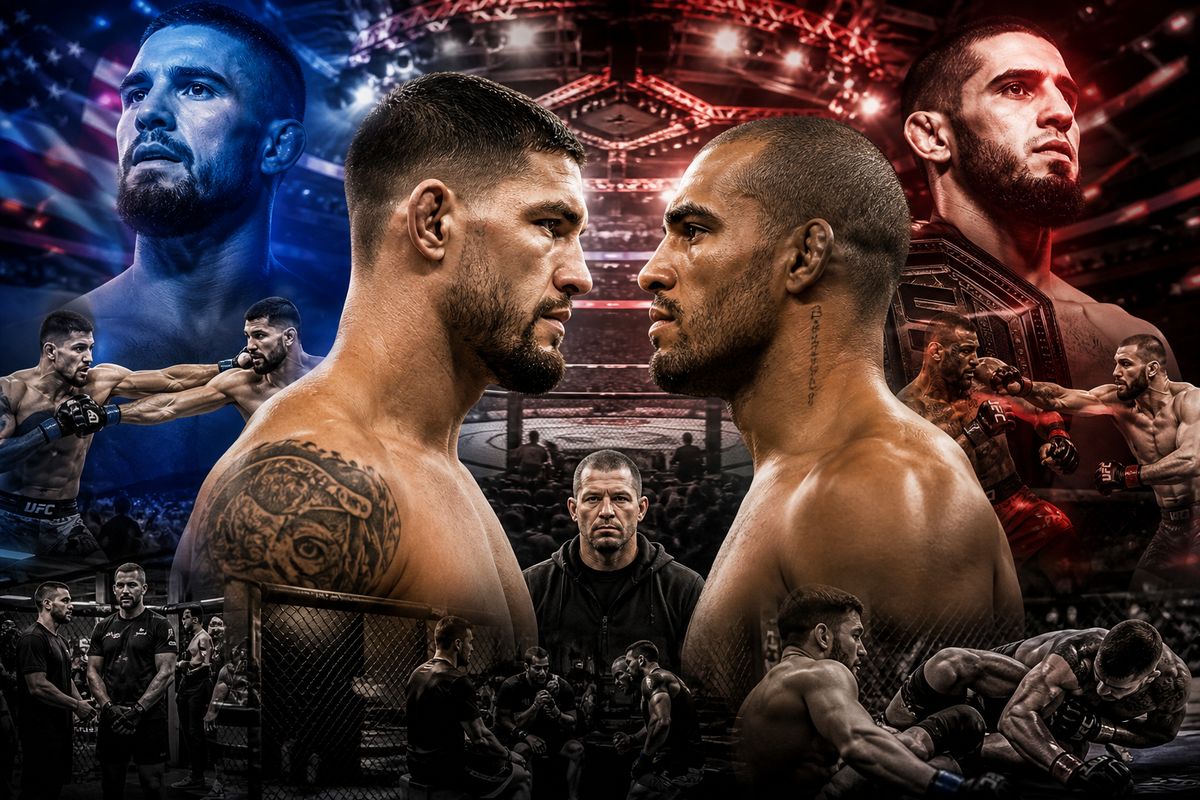
UFC Sacramento main event arrives as the promotion’s next proving ground
The UFC Sacramento main event, Anthony Hernandez vs Gregory Rodrigues, lands on 21 August 2026 as more than a regional stop on the calendar. It becomes a pressure test for two middleweights whose reputations are built on pace, physicality, and a willingness to fight through uncomfortable positions. With the UFC increasingly leaning on fight night headliners to develop contenders outside of pay per view spotlights, Sacramento functions as a live audition for who can carry a card and who can convert momentum into a genuine title run.
Coverage across the MMA media this week frames the bout as both competitive and consequential. Bloody Elbow publishes staff predictions for Hernandez vs Rodrigues on 21 August 2026, underscoring how split opinion is around the match up and how closely observers are watching the stylistic clash. MMA Fighting, meanwhile, highlights Hernandez’s comments that Sean Strickland helped re spark his love for martial arts ahead of the headliner, adding an unusual emotional and cultural layer to a fight that otherwise sells itself on violence and cardio.
The timing matters. The bout sits in the slipstream of a wider UFC conversation dominated by Islam Makhachev’s post UFC 330 surge and the sport’s ongoing GOAT debate, a debate that BJPenn.com and MMA Fighting both note has drawn public scepticism from Jon Jones. In that environment, a fight night main event has to compete for oxygen. Sacramento does so by offering something the current discourse often lacks, a clean, high stakes contest where the winner’s next step is likely clearer than the narratives surrounding championship legacies.
Anthony Hernandez vs Gregory Rodrigues: what is known, and what is being said
On paper, the UFC Sacramento main event is defined by work rate. Hernandez is portrayed this week as a fighter re centred on craft and consistency, with MMA Fighting reporting his view that Strickland helped him rediscover his love for martial arts ahead of the bout. That framing is not trivial. When a fighter speaks about falling back in love with the process, it often signals a shift away from outcome obsession and towards performance, which can translate into calmer decision making under fire.
Bloody Elbow’s staff prediction piece, published on 21 August 2026, positions the headliner as a genuine toss up rather than a showcase. That editorial choice is revealing. Prediction roundups tend to become lopsided when a fight is viewed as a stepping stone. Here, the very existence of a dedicated prediction feature suggests the outlet expects meaningful swings in momentum, and potentially a finish, across five rounds. It also reflects the UFC’s matchmaking logic for fight nights in 2026, put two credible, action first athletes in a main event slot and let the audience decide who deserves the next rung.
Hernandez’s public persona also becomes part of the week’s storyline. Bloody Elbow runs a separate item about Hernandez taking a 100 mg edibles dose that visibly kicks in mid interview, a moment that travels quickly in the attention economy. The UFC has long benefited from viral fight week clips, but they can cut both ways. For Hernandez, the clip risks becoming a distraction, yet it also reinforces a brand of authenticity that fans often reward, particularly when it is paired with a serious performance on fight night.
Rodrigues enters the same spotlight from a different angle. While the supplied source material does not list his full recent results or ranking, the framing of the match up as a headliner and the intensity of the coverage imply the UFC sees him as a credible threat rather than an opponent of convenience. In a five round setting, that typically means the promotion expects durability, composure, and the ability to build offence late, traits that separate highlight reel fighters from main event fighters.
Anthony Hernandez’s Sacramento narrative, Strickland’s influence, and the Xtreme Couture thread
Hernandez’s comments about Sean Strickland resonate because they connect two distinct strands of UFC culture. Strickland is a former champion and one of the promotion’s most polarising personalities, but he is also widely regarded as a gym leader who sets a hard sparring tone and a blunt accountability standard. MMA Fighting’s report that Strickland helped re spark Hernandez’s love for martial arts suggests a mentorship dynamic rooted in routine rather than hype, a reminder that in elite MMA, emotional stability often comes from the daily grind.
BJPenn.com adds another layer by reporting Hernandez praising Xtreme Couture and Strickland ahead of UFC Sacramento. That matters for two reasons. First, it positions Hernandez within a well known training ecosystem that has produced champions and contenders across multiple eras. Second, it frames Sacramento as a moment where gym identity is on display. When a fighter publicly credits a camp, it is often because the camp has helped solve specific problems, whether that is conditioning, defensive habits, or tactical discipline. The source material does not specify which technical changes Hernandez has made, so any claim beyond that would be speculation, but the repeated emphasis on camp and mentorship indicates a deliberate narrative choice from Hernandez and his team.
The Strickland connection also carries a subtle competitive edge. Bloody Elbow notes that in February, Hernandez was stopped by Strickland as his middleweight run developed, a detail that re contextualises the Sacramento headliner. If Hernandez is still processing a stoppage loss to a high profile teammate or rival, the psychological work of returning to a main event slot becomes part of the story. Fighters often talk about “learning” from losses, but the real test is whether those lessons show up when fatigue and adversity arrive in rounds four and five.
In a sport where many athletes change camps frequently, the emphasis on a stable support network is itself a statement. Sacramento becomes a referendum on whether Hernandez’s renewed enthusiasm and camp alignment translate into a disciplined five round performance, the kind of performance that convinces matchmakers to elevate him from headliner to contender.
UFC Sacramento main event in the shadow of UFC 330 and the Makhachev era
The UFC Sacramento main event does not exist in isolation. It takes place in a news cycle dominated by Islam Makhachev’s achievements at UFC 330 and the arguments that follow. BJPenn.com reports that analyst Michael Chiesa says Makhachev should feature on MMA’s Mount Rushmore, and notes that Makhachev’s UFC 330 win over Ian Machado Garry fuels that discussion. BJPenn.com also reports Jon Jones expressing confusion over the GOAT talk following UFC 330, specifically in the context of Makhachev breaking Anderson Silva’s record for most consecutive UFC wins. MMA Fighting similarly covers Jones taking a shot at Daniel Cormier amid the GOAT debate.
That matters for Sacramento because it illustrates how the UFC’s centre of gravity can shift away from active contenders and towards legacy arguments. When the sport’s loudest conversation is about historical ranking, fight nights must offer a different value proposition. Hernandez vs Rodrigues offers immediacy, two athletes trying to force the next opportunity rather than litigate the past. In editorial terms, it is the antidote to discourse fatigue.
There is also a structural point. Makhachev’s run, and the attention it commands, shows how the UFC increasingly rewards long win streaks and narrative clarity. BJPenn.com’s headline about Makhachev embodying discipline, as described by an ex UFC welterweight champion who strayed into a “rockstar life”, reinforces the idea that consistency is the new currency. For Hernandez and Rodrigues, Sacramento is an opportunity to demonstrate that same discipline in a different form, five rounds of controlled aggression rather than a single explosive moment.
Historically, UFC fight nights have served as the proving ground for future pay per view headliners. The difference in 2026 is that the UFC’s content machine is larger and noisier, and a fighter’s ability to cut through it often depends on delivering a performance that is unmissable. Sacramento’s main event is therefore not just about winning. It is about producing a signature that survives the week’s competing headlines.
What Sacramento signals about the UFC’s contender pipeline and matchmaking in 2026
The UFC’s current matchmaking strategy, as reflected in the surrounding headlines, shows a promotion balancing sport, entertainment, and risk management. On the same week as Sacramento coverage, BJPenn.com reports Andre Fili vs Kai Kamaka III being added to UFC Vegas 122, and notes multiple injury related storylines, including a welterweight contender believing Shavkat Rakhmonov will not fight again after injuries, and Yair Rodriguez saying it “wasn’t responsible” to fight Jean Silva at Noche UFC injured. MMA Fighting also reports Rodriguez out of the Noche UFC main event, with Jean Silva getting a new opponent. These items collectively underline a key reality, availability is becoming as important as ability.
In that context, a dependable fight night headliner is valuable. If Hernandez and Rodrigues both make it to the cage and deliver, they strengthen their case as reliable assets in a schedule that is increasingly disrupted by injuries and late replacements. The UFC has always prized fighters who can be trusted to headline on short notice, but the modern calendar, with more events and more global obligations, makes that reliability even more central to career progression.
The Sacramento main event also reflects the UFC’s preference for match ups that answer questions. A five round slot forces a fighter to show pacing, defensive responsibility, and the ability to adjust. Those are the traits that translate to title fights. If the UFC wants to identify who can survive championship rounds, it can either book contenders into eliminators or it can use fight night main events as a filter. Sacramento is the latter, and it is a model the promotion has leaned on for years, but which feels sharper in 2026 as divisions become deeper and the margin for error narrows.
There is a parallel in other parts of the combat sports ecosystem. MMA Fighting covers BKFC president David Feldman reacting to Mike Perry taking a Dillon Danis fight rather than returning to BKFC, while BJPenn.com reports Feldman’s confidence that Perry will fight Darren Till after the Danis bout. The lesson for the UFC is clear, combat sports audiences now follow personalities across promotions and rule sets. To keep fight nights relevant, the UFC has to make them feel consequential. A main event like Hernandez vs Rodrigues is designed to do exactly that, by offering a clear sporting stake rather than a novelty crossover.
The unique tension in Hernandez vs Rodrigues, cardio violence, viral moments, and credibility
Hernandez vs Rodrigues carries a tension that is increasingly common in modern MMA, the push and pull between viral identity and competitive credibility. The edible clip highlighted by Bloody Elbow is a perfect example. It is the kind of content that spreads beyond hardcore fans, but it also risks reducing a fighter to a meme. The only reliable antidote is performance. If Hernandez looks sharp, composed, and relentless over five rounds, the clip becomes colour in a larger story about personality and pressure. If he looks unfocused, it becomes an easy narrative hook for critics.
Rodrigues, by contrast, benefits from being framed primarily through competitive threat. In a media environment saturated with influencer boxing and crossover bouts, the fighters who keep their public image anchored in competition can appear more credible by default. Yet credibility alone does not always translate to attention. The UFC’s challenge, and the fighters’ challenge, is to merge the two, to be compelling without becoming a caricature. Sacramento is a live test of that balance.
There is also a broader cultural shift at play. BJPenn.com’s headline about discipline, using Makhachev as the exemplar, and the repeated references to fighters withdrawing due to injury, point to a sport that is quietly re valuing professionalism. Fans still love chaos, but they also punish unreliability. A five round main event that delivers on its promise, without drama outside the cage, can feel almost radical in 2026. It is not glamorous, but it is what builds contenders.
The most interesting angle is how quickly narratives can flip. A single dominant performance can reposition a fighter from “fun action headliner” to “legitimate top five threat”, even if the official rankings do not immediately reflect it. Conversely, a flat performance can turn a main event slot into a missed opportunity that takes years to recover from. That is why Sacramento matters, not because it crowns a champion, but because it can change the trajectory of two careers in one night.
Historical echoes, from fight night proving grounds to modern main event auditions
UFC fight nights have long been the place where contenders are made. Before the UFC’s schedule expanded, many future title challengers first proved they could handle five rounds in smaller market headliners. The modern version of that pathway is more crowded, with more athletes competing for fewer obvious title shots, but the principle remains. The UFC Sacramento main event is a contemporary audition in a tradition that rewards stamina, adaptability, and mental resilience.
What has changed is the surrounding ecosystem. In earlier eras, a fight night headliner might dominate the week’s conversation by default. In 2026, it competes with a constant stream of content, GOAT arguments, contract rumours, and cross promotion drama. BJPenn.com’s coverage of PFL CEO John Martin slamming “misinformation” around Usman Nurmagomedov’s potential UFC signing is a reminder that even non UFC bouts can influence UFC narratives. MMA Fighting’s feed also highlights Dana White revealing Contender Series fighters have made over $225 million in the UFC, a figure that speaks to the UFC’s talent pipeline and the scale of its recruitment machine.
That recruitment machine increases the pressure on incumbents. If new talent is constantly arriving through the Contender Series and other routes, established fighters cannot afford to coast. Sacramento therefore becomes part of a larger labour market story. A strong main event performance is not just a step towards a title. It is also a defence of relevance in a roster that refreshes itself aggressively.
For fans, the appeal is straightforward. Hernandez vs Rodrigues offers a high effort, high consequence fight that does not require a deep knowledge of promotional politics to enjoy. For the UFC, the appeal is strategic. If the bout delivers, the promotion gains a bankable fight night headliner and potentially a new contender. If it does not, the UFC still learns who cannot be relied upon in the most demanding format.
Closing thoughts: Sacramento’s main event as a referendum on readiness
The UFC Sacramento main event arrives at a moment when the sport’s loudest debates revolve around legacy, streaks, and historical ranking. Against that backdrop, Anthony Hernandez vs Gregory Rodrigues offers something simpler and, in many ways, more honest, two athletes asked to prove they can lead an event and impose their style over five rounds. The week’s reporting, from MMA Fighting’s focus on Hernandez’s renewed love for martial arts to Bloody Elbow’s prediction coverage, frames the bout as a genuine test rather than a foregone conclusion.
For Hernandez, the narrative centres on mentorship, camp identity, and the challenge of turning viral attention into competitive authority. For Rodrigues, the opportunity is to seize a main event platform and force the UFC to treat him as more than a dangerous name on a bout agreement. In a sport where injuries, replacements, and discourse can derail momentum overnight, Sacramento’s headliner is a rare clean line, show up, fight hard, win convincingly, and the next door opens.
Whatever the result, the significance of the UFC Sacramento main event is that it clarifies. It clarifies who can handle five rounds, who can adapt under fatigue, and who can carry the expectations that come with being the last fight on the poster. In 2026’s crowded and noisy MMA landscape, that kind of clarity is increasingly valuable.