

Mixed martial arts belt order becomes a clearer selling point for gyms in 2026
The mixed martial arts belt order is not universally defined in the way many newcomers assume, but in 2026 it is increasingly treated as a practical roadmap by gyms that want to make MMA feel structured, measurable and family friendly. That shift is visible in how modern academies package MMA training, especially for children and teens, using belt colours, timed promotions and age specific classes to turn a complex, multi discipline sport into a progression system parents can understand.
One of the clearest examples comes from Omne MMA in New York City, which presents a belt tracked pathway for young students, alongside a tightly organised class ladder from Mini Ninjas through to Black Belt Class. The gym’s published curriculum outlines not just belt colours but also promotion frequency, recommended weekly attendance and the mix of disciplines taught at each stage, including boxing, kickboxing, Jujitsu, Tae Kwon Do and self defence. In an MMA market crowded with short form advice and social media clips, that kind of specificity is becoming a differentiator.
The immediate newsworthy development is not a single governing body decree, but a visible trend, gyms are formalising belt order and publishing curriculum style pathways as part of their commercial and coaching strategy. The result is a more standardised customer experience, even while the wider MMA world still lacks a single, universally accepted belt hierarchy.
Event details, how one gym sets out its mixed martial arts belt order
Omne MMA’s kids programme is organised by age and experience, starting with Mini Ninjas (ages 3 to 4) and Little Ninjas (ages 5 to 7), before moving into Kids Basic (ages 7 and up) and then Kids Intermediate and Advanced. The gym positions these early stages as foundational, with an emphasis on discipline, coordination, courage and character skills such as communication, teamwork and focus. The structure is explicit, classes run 30 minutes for Mini Ninjas, and 45 minutes for Kids Basic and above.

Where the belt order becomes concrete is in the Kids Basic and Kids Intermediate and Advanced tracks. Omne MMA states that beginner belts are White, Yellow and Orange, and that students wear a white uniform to signify the beginning of training. Promotions for this age group typically happen every 3 to 4 months, and students must demonstrate what they know to be promoted. The gym also provides attendance guidance, beginners can attend 1 to 3 times per week, with a recommendation of 2 times per week at this stage.
For the next stage, Omne MMA lists intermediate belt ranks as Purple, Blue and Green. The gym indicates that intermediate students begin applying beginner skills through sparring, described as simulated fighting drills, while expanding their technical base across disciplines including Muay Thai, Jiu Jitsu, Tae Kwon Do, kickboxing and Krav Maga. Promotion timing is again spelled out, purple and blue promotions usually range from every 3 to 4 months, while green belt promotions happen every 6 to 12 months, depending on participation and progression. Recommended attendance rises to 4 times per week, with a stated range of 3 to 4 times per week.
This is a notable development in how MMA is marketed and taught. Rather than presenting MMA as an open ended mix of striking and grappling, the gym uses belt order, timeframes and class tiers to create a predictable journey. In 2026, that predictability is increasingly important for parents weighing up after school activities, and for adult beginners who want milestones rather than an indefinite grind.
Background, why the mixed martial arts belt order is not universal
Unlike judo, Brazilian jiu jitsu, karate or Tae Kwon Do, MMA is a competition format rather than a single codified martial art with one lineage. That makes belt systems inherently inconsistent. Many MMA gyms borrow belts from traditional arts, some use no belts at all, and others use hybrid systems that reflect their coaching philosophy and the demographics they serve. The result is that a search for “mixed martial arts belt order” often produces confusion, because the answer depends on the gym and the programme.
The source material illustrates that confusion in a subtle way. A TikTok search style page titled “What Color Belts Do Mixed Martial Arts Go Up in” surfaces a scatter of creators and loosely related questions, such as what stripes mean on a white belt, what a red belt indicates, and whether belt systems are the same across martial arts. The material does not provide a definitive belt order, but it does show the demand, people are actively asking for a simple sequence of colours and meanings. In 2026, that demand is amplified by short form platforms, where belt colours become a shorthand for progress, status and identity.
There is also a parallel trend towards subscription based, curriculum led training resources. A separate source describes a “white to Black Belt Curriculum” for juniors and adults, presented as a video aided course used alongside instruction, attributed to Master Weir. It positions itself as a structured journey from white belt to black belt, with techniques and drills required to progress. The material does not specify belt colours in between, but it reinforces the same direction of travel, MMA adjacent training is being packaged as a step by step pathway, not just a collection of classes.
These developments matter because they show how MMA gyms are responding to modern consumer expectations. People want clarity on what they are buying, how long it takes, what the milestones are, and what competence looks like at each stage. Belt order becomes less about tradition and more about product design, coaching accountability and retention.
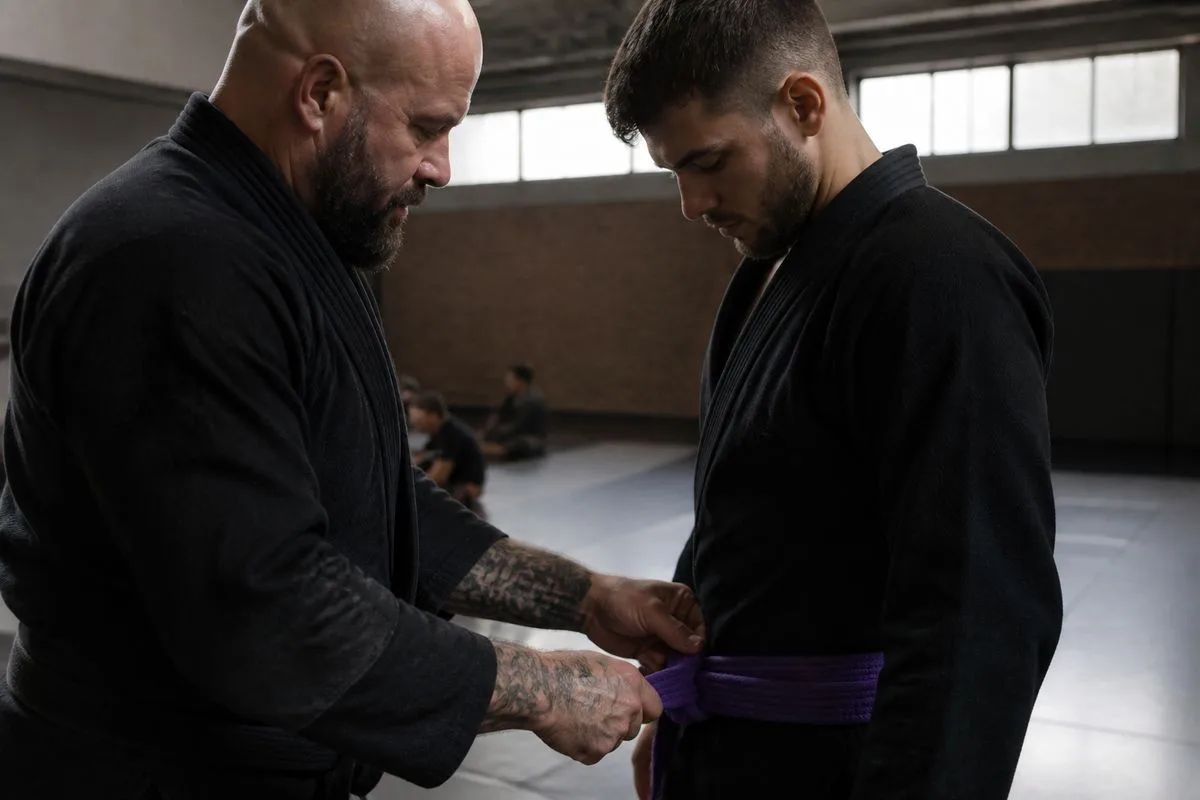
Mixed martial arts belt order in practice, a clear example sequence and what each stage signals
Based on the published Omne MMA kids pathway, one practical mixed martial arts belt order used in 2026 looks like this, White, Yellow, Orange, Purple, Blue, Green, with the longer term goal framed as a journey to Black Belt through advanced classes and a dedicated black belt class. This is not presented as a global MMA standard, but it is a concrete, gym level system that many families will treat as “the” belt order because it is the one they experience week to week.
In that model, the early belts function as a foundation phase. Omne MMA explicitly ties Kids Basic training to building a stronger base before moving into intermediate. The curriculum mix is broad, including Jiu Jitsu, Tae Kwon Do, kickboxing and self defence, which signals a key reality of MMA belt systems, they often represent competence across multiple domains rather than mastery of a single syllabus. The requirement that students “show what they know” to be promoted also highlights a shift away from purely time served promotions, even though typical promotion windows are given.
The intermediate and advanced belt colours, purple, blue and green, are linked to increased training volume and the introduction of sparring as a learning tool. The gym’s recommendation of 4 sessions per week at this stage is telling. It implies that belt progression is not only about skill acquisition but also about consistency and conditioning, which aligns with MMA’s demands. The longer promotion window for green belt, 6 to 12 months, also signals a bottleneck, a deliberate slowing of progression as students approach higher competency.
For parents and adult beginners, the practical takeaway is that belt order is best read as a local contract between gym and student. It sets expectations, how often to train, what disciplines will be covered, and roughly how long it might take to move through ranks. In 2026, that contract is increasingly written down, published and used as a trust building tool.
Industry analysis, why gyms are standardising belt order and curriculum pathways
The move towards clearer belt order systems reflects a wider professionalisation of MMA coaching at grassroots level. MMA has long been associated with competition teams and hard sparring cultures, but the commercial growth area is beginners, children and teens. A belt pathway helps gyms translate a complex sport into something that resembles other structured activities, with levels, assessments and visible progress. Omne MMA’s age segmented ladder, from Mini Ninjas to Teens to leadership and competition team opportunities, reads like a modern youth development programme rather than an informal fight gym.
There is also a retention logic. When promotions are described as happening every 3 to 4 months for several ranks, students and parents can anticipate near term milestones. That can reduce drop off in the early months, when novelty fades and progress feels slow. At the same time, the longer window for green belt, 6 to 12 months, suggests gyms are trying to balance motivation with credibility. If belts come too quickly, they lose meaning. If they come too slowly, families may disengage. The published timeframes show an attempt to engineer that balance.
Social media demand adds pressure for clarity. The TikTok style source material shows belt questions being asked in a fragmented way, with users seeking simple answers about colours, stripes and meanings. Gyms that can provide a clean explanation of their belt order and what each rank represents are better positioned to convert that attention into enrolments. In 2026, belt order becomes part of a gym’s brand narrative, a way to show seriousness, safety and progression without relying on competition results.
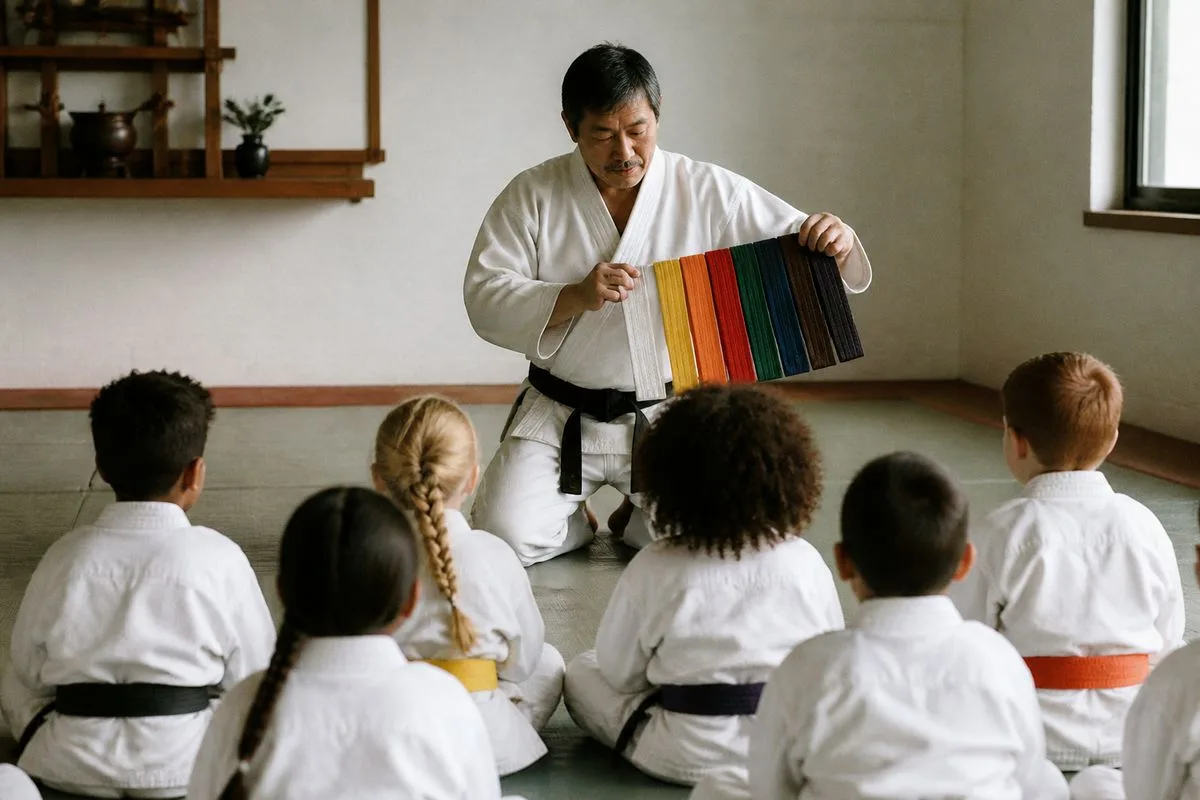
Finally, curriculum products, such as the “white to Black Belt Curriculum” described in the source material, point to a hybrid model of coaching. Video libraries and monthly subscriptions are used as aids to in person classes. That approach can standardise instruction across coaches, reduce inconsistency, and give students a reference point at home. For belt systems, it also creates a paper trail of what is required, which can make promotions feel more defensible and less subjective.
How to interpret belt order responsibly, especially for children and new starters
For families, the most important point is that belt colours in MMA do not automatically map to belt colours in other martial arts. A purple belt in one system may not represent the same skill set as a purple belt in another. Omne MMA’s pathway, for example, blends multiple disciplines and sets promotion timing expectations. That is different from a single art belt system where the syllabus is fixed and widely recognised. In practice, the belt is best understood as a marker of progress within that specific programme.
Omne MMA’s youngest classes also show that early training is not primarily about fighting. Mini Ninjas classes are described as including warm ups, a focus talk, athletic conditioning, obstacle courses and logical brain games, alongside learning a technique. The stated character outcomes, communication, teamwork and focus, are central. That matters when interpreting belt order, because early belts may reflect behavioural and developmental milestones as much as technical prowess.
For older children moving into Kids Basic and beyond, the published requirement to demonstrate knowledge for promotion provides a useful consumer check. Parents can ask what “show what they know” means in practice, whether it is a formal grading, a coach assessment, or a set of required techniques. They can also compare the recommended attendance, such as 2 sessions per week for beginners and 4 sessions per week for intermediate, with what their child can realistically sustain. A belt system that assumes unrealistic training volume may create pressure rather than progress.
For adult beginners, the lesson is similar. A “white to black belt” promise can be motivating, but it should be interrogated. The source material describing a curriculum subscription does not list intermediate belt colours or timeframes, so it cannot be used to estimate how long progression takes. In 2026, consumers benefit from asking for specifics, what are the ranks, what are the requirements, how often are assessments held, and what skills are expected at each level.

What’s Next
In the near term, more MMA gyms are likely to publish their belt order and promotion cadence in the same way Omne MMA does, not because the sport suddenly needs belts, but because customers do. As competition for family memberships intensifies, programmes that clearly separate age groups, define class lengths and outline promotion windows will look safer and more professional to parents. That is especially true in large cities, where extracurricular choices are abundant and switching costs are low.
A second likely development is greater convergence around a handful of belt sequences, even without a global governing body. When prospective members repeatedly search for “mixed martial arts belt order” and see similar colour progressions across multiple gyms, expectations begin to standardise from the bottom up. That does not create a true universal system, but it does create market pressure. Gyms that use highly unusual belt colours or opaque promotion rules may find they have to explain themselves more clearly, or risk losing enquiries to competitors with simpler messaging.
Finally, curriculum backed training, including video libraries used as aids to in person coaching, is likely to become more common. The appeal is consistency, students can review techniques, coaches can align on what each belt requires, and promotions can be tied to a documented syllabus. If that trend accelerates, belt order in MMA will become less about tradition and more about quality assurance. The gyms that thrive will be those that can prove their belts represent real competence, while still keeping the journey engaging enough to retain students through the slower, harder ranks.
Closing thoughts, the belt order matters because it shapes expectations
The mixed martial arts belt order remains a local system rather than a universal language, but in 2026 it is increasingly central to how MMA is taught and sold to mainstream audiences. Omne MMA’s published pathway, with beginner belts White, Yellow and Orange, intermediate ranks Purple, Blue and Green, and typical promotion windows of 3 to 4 months for several stages and 6 to 12 months for green, shows how detailed these systems can be when a gym chooses transparency.
The broader context is a sport maturing beyond its competition roots into a mass participation activity. Belt order, class ladders and curriculum resources are tools that make MMA legible to parents, beginners and time poor adults. The key is to treat belts as what they are, a structured measure of progress within a specific programme, not a universally comparable credential. For anyone searching for a definitive belt sequence, the most accurate answer is also the most practical one, ask how a particular gym defines its belt order, what it requires, and how it supports students to earn each step.