
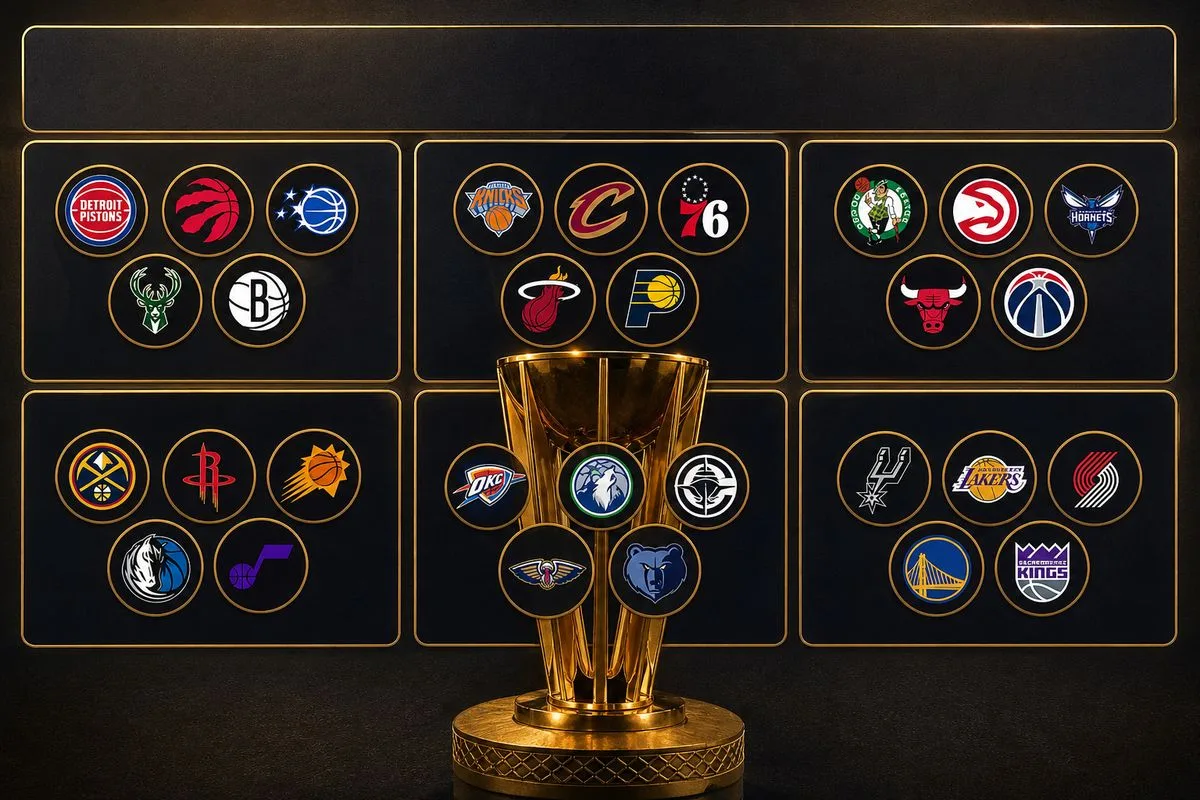
NBA standings shift fast in NBA Cup 2026 group play
The phrase nba standings usually sends fans straight to the familiar conference tables, but in November 2026 there is a second, parallel race that matters just as much. The NBA Cup group stage creates its own standings, its own tie breakers, and its own urgency, and the results from the latest round of games materially change who controls their path to the knockout rounds.
As of mid November 2026, several groups already have a clear frontrunner, while others are defined by one or two unexpected outcomes. The New York Knicks sit at 0-2 in East Group B after losing to the Indiana Pacers, a result that forces them into must win territory with two games left. In the West, the Los Angeles Clippers deliver the most eye catching surprise by beating the Oklahoma City Thunder at home, a single result that reduces Oklahoma City’s margin for error in West Group B.
These NBA Cup standings are not a side show. They influence scheduling intensity, rotation decisions, and the way teams approach point differential, which is explicitly listed alongside win loss record in the group tables. In other words, the standings are not only about who wins, but also about how convincingly they do it, and that changes coaching behaviour in ways the regular season table rarely does.
What happens on 13 and 14 November 2026, and why it matters
The latest movement in the NBA Cup tables follows a night of games on 13 November 2026, with analysis and updated group standings circulating on 14 November 2026. The headline outcomes are straightforward, but their implications are not. The Knicks’ loss to Indiana drops New York to 0-2 in East Group B. The Chicago Bulls beat the Atlanta Hawks in overtime without rookie phenom Caleb Wilson, a result that further stabilises Boston’s position atop East Group C. Out West, the Clippers’ win over Oklahoma City is the kind of upset that changes the arithmetic for everyone in the group.
In East Group B, the standings show Miami at 2-0 with a +32 point differential, Cleveland at 1-1 with +12, Indiana at 1-1 with -18, Philadelphia at 1-1 with -19, and New York at 0-2 with -7. That is a table where one more result can flip the order, but it is also a table where the Knicks no longer control their destiny. They need to beat both Miami and Cleveland, and then rely on help elsewhere to climb back into contention.
In West Group B, Minnesota leads at 2-0 with a +32 differential, Oklahoma City is 1-1 with +30, Memphis is 1-1 at 0, the Clippers are 1-1 at -25, and New Orleans is 0-2 at -37. The key point is that Oklahoma City’s point differential remains strong, but the loss removes the cushion that often allows a team to advance as the best second place finisher. In this format, a single upset can turn a comfortable scenario into a situation where every remaining possession matters.
NBA standings in the NBA Cup 2026: the group tables right now
To understand the story fans are actually following when they search nba standings in November, it helps to lay out the NBA Cup group tables as they stand in the source material. In the East, three groups show very different shapes. East Group A is led by Orlando at 2-0 with a +15 point differential. Detroit sits at 1-0 with +16, Toronto is 1-1 with +7, Brooklyn is 0-1 with -16, and Milwaukee is 0-2 with -22. The immediate takeaway is that Orlando is perfect so far, but Detroit’s single win has been emphatic enough to keep them in striking distance on differential.
East Group C looks closer to a runaway. Boston is 2-0 with a massive +53 differential, Washington is 1-1 with +9, Atlanta is 1-1 with -1, Chicago is 1-1 with -6, and Charlotte is 0-2 with -55. A +53 differential after two games is not just winning, it is winning in a way that makes tie breaker scenarios feel remote. The Bulls’ overtime win over Atlanta, achieved without Caleb Wilson, further reduces the number of plausible paths for anyone to catch Boston.
In the West, West Group A is the most obviously competitive table. Dallas leads at 2-0 with +17, Denver is 1-0 with +7, Houston is 1-1 with +2, Phoenix is 0-1 with -7, and Utah is 0-2 with -19. This is the kind of group where schedule quirks matter, and the source material notes that Denver benefits from having key matchups at home, a small edge that can loom large when the margins are tight.
West Group C has a clear leader. San Antonio is 2-0 with +53, Portland is 1-1 with +7, the Los Angeles Lakers are 1-1 with -11, Golden State is 1-1 with -21, and Sacramento is 0-2 with -28. The Spurs’ early dominance mirrors Boston’s in the East, and the differential suggests they are not merely edging games, they are controlling them.
Teams under pressure: Knicks, Thunder and the new reality of point differential
No team wears the spotlight like the Knicks when the standings turn against them, and the NBA Cup format makes their situation even harsher. At 0-2 in East Group B, New York is not mathematically eliminated, but the path is narrow. The source material frames it bluntly: New York needs to beat both the Miami Heat and the Cleveland Cavaliers, then receive help. The small mercy is location, both remaining group stage games are at home, which at least gives the Knicks a familiar environment as they attempt to rescue their campaign.
The pressure is not only about wins. New York’s point differential is -7, which is not catastrophic, but it is also not the kind of number that suggests a team is unlucky. It implies close games that still ended the wrong way, and in a tournament table, close losses are still losses. That is why the NBA Cup standings feel different from the regular season standings. In the regular season, a team can lose a couple of tight games and still trust the long arc of 82 games. In the Cup, the sample is small and the tie breakers are immediate.
Oklahoma City faces a different kind of squeeze. The Thunder remain 1-1 with a strong +30 differential in West Group B, but the loss to the Clippers removes the buffer that might have allowed them to advance as the best second place team. The next pivotal date is already circled, Oklahoma City hosts the Minnesota Timberwolves on 25 November 2026 in a matchup widely expected to decide first place in the group. The source material is clear about the stakes, the Thunder have to avoid a loss because advancing with two losses is difficult in this format.
There is also a form question embedded in the standings. Oklahoma City carries a three game losing streak that includes back to back defeats to the Portland Trail Blazers, according to the source material. That matters because tournament games do not exist in isolation. If a team is struggling in the broader regular season rhythm, the Cup game becomes both a standings event and a psychological test, a chance to either reset momentum or deepen a slump.
Contenders and control: Celtics, Magic, Spurs and the race to cruise
While some teams scramble, others are already shaping the bracket through dominance. Boston’s position in East Group C is the clearest example. At 2-0 with a +53 differential, the Celtics are not simply leading, they are building a tie breaker moat. The source material points to a schedule that reinforces that advantage, Boston visits the Washington Wizards on 24 November 2026 and then hosts the Atlanta Hawks on 27 November 2026 to close out group play. With Jayson Tatum identified as the face of the side, the expectation is that Boston wins both games, which would make their group win feel procedural rather than dramatic.
Orlando’s situation in East Group A is less explosive but still favourable. The Magic are 2-0 with a +15 differential, and the key fixture is a home game against the Detroit Pistons on 24 November 2026, described as the likely decider for the group. Detroit’s broader form is noted, an 8-3 start to the season, and the scheduling context is important, the Pistons arrive in Orlando at the end of a stretch where they play five of six on the road. In a league where travel and rest shape performance, that detail is not trivia, it is part of the standings logic.
In the West, San Antonio’s grip on West Group C mirrors Boston’s. The Spurs are 2-0 with a +53 differential, and the source material suggests they are likely to run away with the group after proving they can win big on the road in Portland. The Lakers and Warriors sit at 1-1 but with negative differentials, which is the worst of both worlds in a Cup table, it means they are not only dropping games, they are losing the tie breaker battle at the same time.
The contrast between these leaders and the chasing pack is the story inside the standings. In the NBA Cup, a team that wins big early can effectively force opponents to play a different sport, one where late game decisions are shaped by arithmetic. Coaches who would normally slow the pace with a lead may keep starters in longer, not to run up the score for vanity, but because point differential is explicitly part of the standings.
The Bigger Picture
The NBA Cup standings highlight a broader shift in how the league manufactures meaning inside the regular season. For decades, the primary standings story is a slow burn, conference position, head to head tie breakers, and the grind of injuries and road trips. The Cup injects a second standings narrative that is sharper and more volatile, and it changes incentives in ways that are visible even to casual fans. When point differential is printed next to win loss record, every possession becomes a potential standings event, not just a moment in a single game.
This is also why the Cup can reshape public perception of teams before the traditional standings settle. A club like Detroit, listed at 1-0 in East Group A with a +16 differential and an 8-3 overall start, can use the Cup to accelerate legitimacy, especially if it can challenge Orlando on 24 November 2026. Conversely, a high profile team like New York can find itself fighting a narrative that the regular season table might eventually soften. In a small group stage, the standings do not wait for regression to the mean.
There is a competitive balance angle too. Upsets like the Clippers beating the Thunder are not just fun, they are structurally important. A format that rewards single game performance and differential creates more pathways for disruption, which can keep more fanbases engaged deeper into November. That matters in an era where attention is fragmented and where leagues compete not only with each other, but with every other entertainment option. The Cup standings are, in effect, a second product layered onto the first, and the league’s bet is that fans will check standings more often because there are now more standings that matter.
What to watch next in the NBA standings race, key dates and scenarios
The next phase of the NBA Cup standings story is defined by a handful of dates that function like mini elimination nights. In the East, Orlando hosting Detroit on 24 November 2026 is positioned as a likely decider for East Group A. The context around Detroit’s travel heavy stretch suggests fatigue could be a factor, but the standings also suggest Detroit has the differential profile to compete even if the win loss record is tight. If Orlando wins, it likely turns the group into a chase for second place and differential.
East Group B is the group to monitor for chaos. Miami sits at 2-0 with a strong differential, but the table is compressed behind them, and the source material notes a plausible path for Philadelphia to win the group. The Sixers, at 1-1, benefit from the way results have opened up the maths, with a route involving wins over Miami and Indiana and some help elsewhere. The detail that matters is tie breakers, Philadelphia would need Cleveland to lose one more time to avoid losing the group on a head to head tiebreaker. That is a reminder that the standings are not only about record, they are about who beats whom, and in what order.
In the West, Oklahoma City hosting Minnesota on 25 November 2026 is the marquee standings hinge. Minnesota is 2-0 with +32, Oklahoma City is 1-1 with +30, and the source material notes Minnesota’s schedule advantage, their only road trip in the next two weeks is to Oklahoma City. That kind of rest profile can show up in late game execution, which is exactly where differential can swing. Meanwhile, West Group A remains a three team race between Dallas, Denver and Houston, with Houston visiting Denver in a game the Rockets “have to win” after already losing to Dallas. The Nuggets’ home scheduling edge could be decisive in a group where one loss can force a team into scoreboard watching.
Closing thoughts: why NBA Cup standings now shape the season conversation
In November 2026, the most useful way to think about nba standings is as a layered concept. There is the long season table that ultimately decides playoff seeding, and there is the NBA Cup table that decides who advances, who hosts, and who is forced into high leverage games earlier than expected. The Cup standings are not replacing the traditional standings, but they are changing what matters on a given night, and they are doing it in a way that is easy to follow because the numbers are simple and the consequences are immediate.
The current tables show both the promise and the cruelty of the format. Boston and San Antonio are already building commanding leads through dominant differentials. Orlando is positioned to control its group with one key home game. New York is in a hole that would feel manageable in an 82 game context, but is perilous in a short group stage. Oklahoma City’s upset loss to the Clippers does not end its campaign, but it turns the Minnesota game into a near must win, and it forces the Thunder to treat every remaining Cup possession as a standings asset.
That is the central lesson of this week’s movement. The NBA Cup is teaching teams, and fans, to read standings differently. It is not only about who is above the line, it is about the margins that create or remove safety. With several decisive fixtures still to come in late November 2026, the standings story is not settling down, it is accelerating.